
When you take medication for your mental health, you trust the professionals caring for you to take your concerns seriously.
I raised concerns with both my GP and my Community Mental Health Team (CMHT) about symptoms I was experiencing while taking venlafaxine. What made the situation even more frustrating was that, when I later looked at the NHS information about venlafaxine, I found that some of the symptoms I had experienced were listed among the warning signs requiring medical attention.
Yet when I raised my concerns, I didn’t feel listened to.
My experience left me asking a difficult question: What are patients supposed to do when they recognise a potential red flag, tell the professionals responsible for their care, and still feel that nobody is taking them seriously?
This isn’t about telling other people whether they should or shouldn’t take venlafaxine. Medication affects everyone differently, and decisions about starting, stopping or changing antidepressants should be made with appropriate medical advice.
It’s about something much simpler: being heard when you say that something doesn’t feel right.
If official health information tells patients to seek medical help for particular symptoms, those concerns deserve to be taken seriously when a patient reports them.
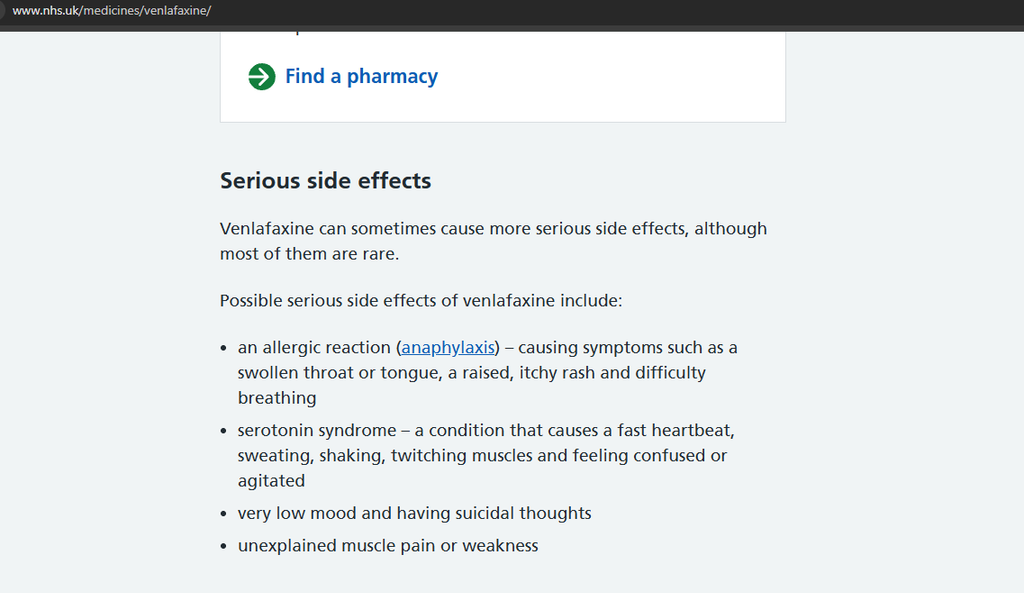
Click on the above image to be taken to the NHS website, the red flags are half way down – towards the bottom of the page.
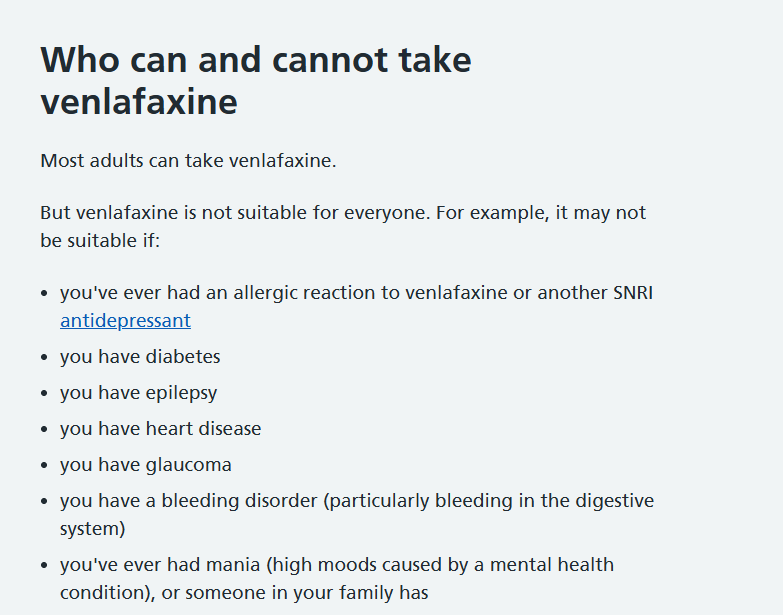
Also I noticed this medication is not suited for diabetics, myself personally I am a type one diabetic.
There is a particular kind of helplessness that comes from knowing something is wrong, asking for help, and still feeling as though nobody is listening.
I had reached a point where I was kept in my local hospital while waiting for a mental-health bed. I waited, but the bed never became available. Eventually, rather than receiving the inpatient care I had been waiting for, I was placed under the care of the Home Treatment Team.
That might sound like support. In reality, my experience was very different.
I was given a substantial amount of paperwork to complete. The problem was that, because of my autism, I found much of it difficult to understand and process. What may have appeared straightforward on paper was not straightforward for me.
I needed someone to recognise that and adapt their approach.
Instead, I felt as though I was being given tasks that I simply wasn’t equipped to deal with at that point in my life.
There was another aspect that made things even harder. One of the people involved in my care had a heavily tattooed appearance that I found extremely difficult to look at and which made me physically uncomfortable. I understand that other people may have no issue with tattoos whatsoever. For me, however, it triggered such a strong reaction that it made an already frightening situation even harder to cope with.
This is where reasonable understanding and individualised care should matter.
Mental-health care cannot simply be about ticking boxes, handing someone paperwork and saying that support has been provided. The way support is delivered matters.
For someone with autism who is already overwhelmed, frightened or struggling to process information, communication needs to take those difficulties into account.
I had already tried to tell professionals about my concerns. I had spoken to my GP and the mental-health services involved in my care. I felt that the concerns I was raising about venlafaxine and the symptoms I was experiencing weren’t being taken seriously.
And then I found myself in hospital, waiting for a mental-health bed that never came.
Eventually, I was sent home with a service that, from my perspective, didn’t feel like the support I desperately needed.
This isn’t an argument that every member of the NHS doesn’t care. It is an account of what being failed by the system felt like to me.
When someone is unwell enough to be kept in hospital while waiting for a psychiatric bed, they shouldn’t have to fight to make themselves understood.
They shouldn’t have to become an expert in navigating mental-health services while they’re already struggling.
And they shouldn’t have to wonder whether anyone is actually listening.
I was asking for help. I needed to be heard. I needed my autism to be understood. And, most importantly, I needed my concerns about my medication and my mental health to be taken seriously.
There is a particular kind of helplessness that comes from knowing something is wrong, asking for help, and still feeling as though nobody is listening.
I had reached a point where I was kept in my local hospital while waiting for a mental-health bed. I waited, but the bed never became available. Eventually, rather than receiving the inpatient care I had been waiting for, I was placed under the care of the Home Treatment Team.
That might sound like support. In reality, my experience was very different.
I was given a substantial amount of paperwork to complete. The problem was that, because of my autism, I found much of it difficult to understand and process. What may have appeared straightforward on paper was not straightforward for me.
I needed someone to recognise that and adapt their approach.
Instead, I felt as though I was being given tasks that I simply wasn’t equipped to deal with at that point in my life.
There was another aspect that made things even harder. One of the people involved in my care had a heavily tattooed appearance that I found extremely difficult to look at and which made me physically uncomfortable. I understand that other people may have no issue with tattoos whatsoever. For me, however, it triggered such a strong reaction that it made an already frightening situation even harder to cope with.
This is where reasonable understanding and individualised care should matter.
Mental-health care cannot simply be about ticking boxes, handing someone paperwork and saying that support has been provided. The way support is delivered matters.
For someone with autism who is already overwhelmed, frightened or struggling to process information, communication needs to take those difficulties into account.
I had already tried to tell professionals about my concerns. I had spoken to my GP and the mental-health services involved in my care. I felt that the concerns I was raising about venlafaxine and the symptoms I was experiencing weren’t being taken seriously.
And then I found myself in hospital, waiting for a mental-health bed that never came.
Eventually, I was sent home with a service that, from my perspective, didn’t feel like the support I desperately needed.
This isn’t an argument that every member of the NHS doesn’t care. It is an account of what being failed by the system felt like to me.
When someone is unwell enough to be kept in hospital while waiting for a psychiatric bed, they shouldn’t have to fight to make themselves understood.
They shouldn’t have to become an expert in navigating mental-health services while they’re already struggling.
And they shouldn’t have to wonder whether anyone is actually listening.
I was asking for help. I needed to be heard. I needed my autism to be understood. And, most importantly, I needed my concerns about my medication and my mental health to be taken seriously.
Looking back, what happened to me was not one isolated incident. It was a series of events during a period when I was already extremely vulnerable.
I had raised concerns about venlafaxine and the symptoms I was experiencing. I was kept in hospital while waiting for a mental-health bed, but that bed never materialised. I was then placed under the care of the Home Treatment Team.
I struggled with the paperwork I was given because of my autism. I needed information to be explained in a way that I could understand and process. Instead, I often felt overwhelmed by the expectations being placed on me.
Then there was my GP.
In the middle of this crisis, my GP decided to discharge me from the practice. I found this extremely difficult and felt abandoned at a point when I needed continuity and support.
I was also running low on insulin, which added another layer of anxiety to an already frightening situation.
There were other experiences with the surgery that have stayed with me. When I spoke to my GP about my sexual identity, he physically hugged me. I found this uncomfortable and inappropriate, and I felt that my concerns about the incident were not properly addressed.
I was also asked to sign a behavioural agreement that I did not fully understand. Because of my autism, I needed the information explained clearly and in a way that I could process. I did not feel that happened.
On another occasion, I missed a meeting with the practice manager. The reason was not that I had simply decided not to attend. I was in hospital receiving a life-saving drip.
These details matter because, when viewed individually, they might be dismissed as misunderstandings, missed appointments or administrative problems.
But they weren’t isolated events to me.
They happened while I was already in crisis.
And throughout all of this, I kept trying to communicate that I was struggling.
This Isn’t Just About Venlafaxine
The NHS recognises that venlafaxine can cause serious side effects and provides specific warnings about symptoms that require urgent medical attention. It also advises people not to stop the medication suddenly without speaking to a doctor.
My point isn’t that everyone taking venlafaxine will experience what I experienced. Nor am I saying that people should stop taking it.
My point is that when a patient raises concerns about possible serious side effects, those concerns deserve to be properly heard and assessed.
And when that patient is autistic, communication needs to take their individual needs into account.
I needed someone to slow things down.
I needed someone to explain things clearly.
I needed someone to check that I had actually understood what I was being asked to do.
I needed reasonable adjustments.
Most of all, I needed to feel that the people responsible for my care were actually listening.
Instead, I repeatedly felt that I was being passed from one service to another while trying to navigate a system that I was struggling to understand.
I don’t write this because I expect everyone to agree with every part of my experience.
I write it because this is what happened from my perspective, and this is how it felt to live through it.
When somebody is in mental-health crisis, the answer cannot simply be more paperwork, more appointments and more instructions.
Sometimes the most important thing a healthcare professional can do is stop, listen and ask:
“What do you need from us right now?”
I needed help.
I needed understanding.
And I needed someone to listen.